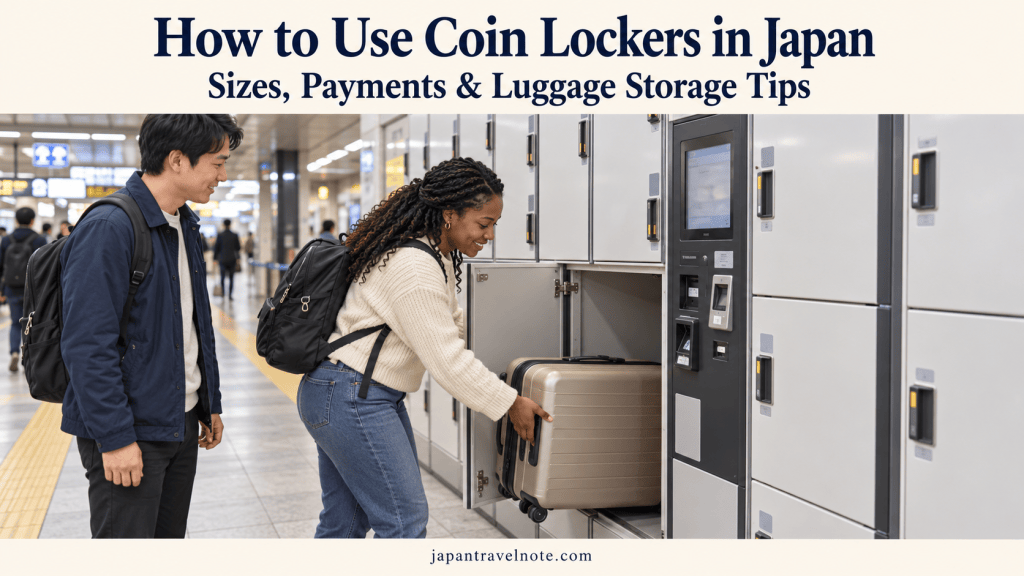
Coin lockers in Japan let you store bags while you explore, but the payment and collection method depends on the machine. Some use a physical key, some use the same transport IC card you paid with, and others issue a receipt with a PIN or retrieval code. Before leaving, check that the door is locked and that you have what you need to open it again. (cht.kokusen.go.jp, keiochika.co.jp, visitnikko.jp)
They can be especially useful after hotel checkout, before check-in or during a sightseeing stop between train journeys.
Here is how to choose a locker, store your suitcase and collect it without confusion.
Where Can You Find Coin Lockers in Japan?
Coin lockers are available at many railway stations and tourist facilities. Larger stations may have several locker areas, sometimes on different floors or on opposite sides of the ticket gates. (japan.travel, multiecube.com)
Look for a suitcase or locker symbol on the station map, or ask staff where the nearest lockers are.
Before paying, check:
- Whether the locker is inside or outside the ticket gates.
- Whether you can return to that area later.
- The hours when you can access it.
- The operator’s contact details.
A locker inside a paid station area may be inconvenient if you have already finished your train journey. Choose a location that fits your return route.
My suggestion: photograph the locker area, its number and the nearest named exit or landmark. A compartment number alone may not help you find the correct locker bank in a large station.
What Size Locker Do You Need?
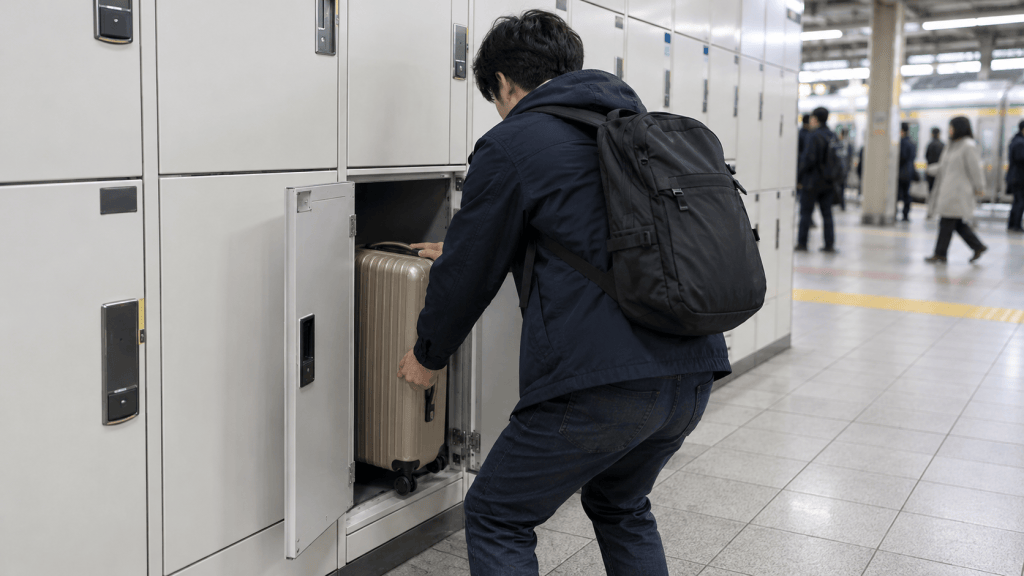
Lockers come in different sizes, but labels such as small, medium and large are not standard measurements across Japan.
As a starting point:
- Small lockers may suit handbags, shopping bags or compact backpacks.
- Medium lockers may fit larger bags or some small suitcases.
- Large lockers may accommodate a suitcase, depending on its dimensions.
Check the actual compartment before committing. Include your suitcase’s wheels, handles and any bulging pockets when assessing the fit.
Fold down the telescopic handle, tuck in loose straps and make sure nothing catches in the door. Do not force an oversized bag inside.
The right locker is one where the bag fits comfortably and the door closes normally.
How Much Do Coin Lockers Cost?
Prices depend on the location, compartment size and charging system.
For a concrete example, Metro Commerce’s Tokyo station listings include locker prices such as 300, 500, 600, 900 and 1,000 yen, with availability varying by station. Larger or specialist compartments elsewhere can cost more. (metocan.co.jp, narita-airport.jp)
Treat those as examples—not a nationwide price list. Check the amount displayed on your chosen locker.
Also check whether the price is charged:
- Per use and day.
- In timed blocks.
- With a separate reservation fee.
Do not assume a displayed “daily” fee buys a full 24 hours from the moment you pay. (keiochika.co.jp, multiecube.com)
How to Use a Key-Type Coin Locker
For a traditional locker with a physical key, follow the instructions printed on that unit. A typical process is:
- Find an available compartment with its key attached.
- Put your luggage inside.
- Pay the displayed amount using the accepted coins.
- Close the door and turn the key as instructed.
- Remove the key and keep it with you.
- Check that the door is locked.
Some traditional lockers use 100-yen coins. Do not assume they accept banknotes, credit cards or every coin denomination. (visitnikko.jp)
When collecting your bag, use the key and follow any instructions for paying an additional fee if the charging period has rolled over.
Never leave the key inside the luggage you are storing.
How to Use a Touchscreen Locker With Suica or Another IC Card
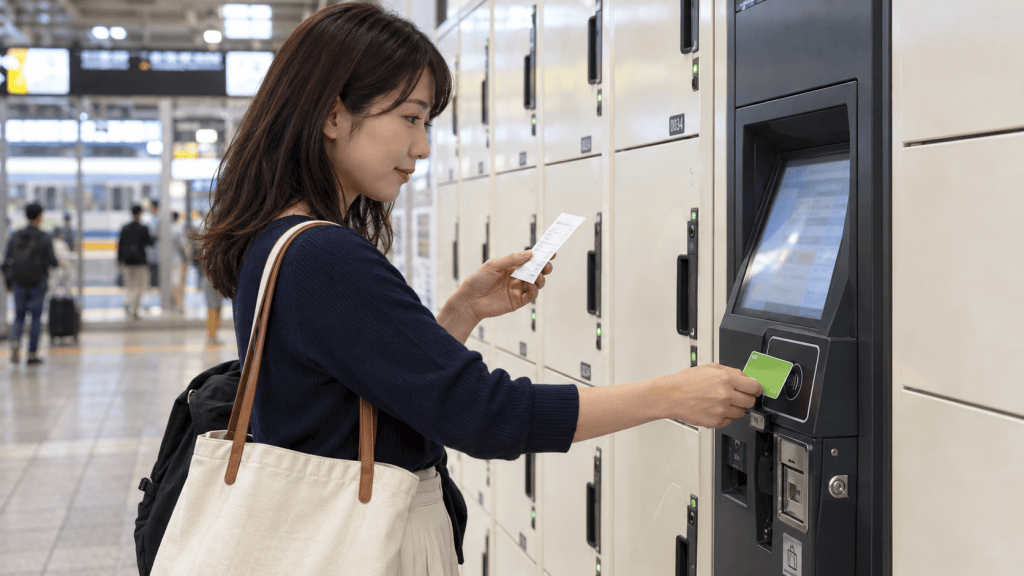
At a locker accepting your transport IC card, the card may act as both payment method and key.
The exact sequence varies, but it commonly involves:
- Choose an available compartment and put your bag inside.
- Close the door as instructed.
- Follow the terminal prompts and confirm the correct locker number.
- Select the supported IC-card payment option.
- Tap your card on the reader.
- Take the receipt and confirm that the locker is secured.
To collect your luggage, select the retrieval option and use the same IC card. (jreast.co.jp)
Another Suica belonging to a travel companion is not the same key. Keep track of which card you used.
If the locker accepts your mobile IC card, keep that device available and charged for collection. Avoid transferring or changing the card while it is being used as your locker key.
Not every locker accepts Suica, and payment options differ. Check the logos and instructions on the actual terminal.
For more about choosing and using a transport card, read my beginner’s guide to Suica in Japan.
How to Use a Cash Touchscreen Locker
Some electronic lockers accept cash and print a receipt containing a PIN or another retrieval code.
A typical process is:
- Put your bag in the compartment and close the door as instructed.
- Confirm the locker number at the terminal.
- Select cash payment.
- Pay using the accepted coins or banknotes.
- Collect your receipt and any change.
- Check that the door is locked.
For collection, choose the retrieval option and follow the instructions to enter the PIN or use the code on your receipt. (keiochika.co.jp)
Keep the original receipt until you have collected everything. A private backup photo can be useful, but do not assume it replaces the original ticket for every machine.
Treat the retrieval code like a key. Do not share a readable photo of it publicly.
Before Locking the Door: Keep These With You
Take out anything you will need before you return:
- Passport, wallet and payment cards.
- Phone and charger or power bank.
- Essential medication.
- Train tickets and booking details.
- The card, key or receipt needed to reopen the locker.
- A jacket, umbrella or children’s essentials for the day.
Check the operator’s prohibited-item rules. For example, locker terms may exclude cash, valuables, dangerous items, perishables and other unsuitable contents. (metocan.co.jp)
A coin locker is a place for suitable luggage, not a substitute for keeping important documents and valuables with you.
Can You Leave Luggage Overnight?
Only if the locker’s rules and access hours allow it.
There are two separate questions:
When does another fee become due?
Some daily lockers add another day’s charge at a fixed time. For example, Metro Commerce’s published terms use 2 a.m. as the daily rollover. This means an evening deposit followed by collection the next morning can incur two days’ charges, even though fewer than 24 hours have passed. (metocan.co.jp)
How long may the bag stay?
There is no single nationwide limit. Keio’s published terms specify up to three consecutive days including the first day, while Metro Commerce’s terms specify up to four days including the first day. (keiochika.co.jp, metocan.co.jp)
Read the rule displayed at your locker. Overstaying can result in the contents being removed for separate storage, with further procedures and charges.
Also remember that a locker may be inaccessible while the station or building is closed. A fee rollover time is not a promise of overnight access.
Can You Open the Locker and Use It Again?
Do not assume your payment includes unlimited opening and closing.
Retrieval may end the rental, meaning you need to start a new paid session to store your luggage again. Check the instructions before opening it for one small item. (jre-sl.co.jp)
It is easier to separate your day bag before paying.
What If All the Lockers Are Full?
Try these alternatives:
- Look for another locker area shown on the station map.
- Ask about a staffed luggage-storage counter.
- Ask your hotel whether it can keep bags before check-in or after checkout.
- Check an available reservation service for a suitable locker or staffed storage location.
JNTO notes that lockers can fill quickly in busy locations. Do not build a tight itinerary around finding a large empty compartment immediately. (japan.travel)
Before booking an alternative, check its actual location, hours, bag-size limits and collection deadline.
If your suitcase is moving to a different city, hotel-to-hotel luggage forwarding may be more suitable than returning to the same locker. Confirm the delivery arrangements and keep your essentials with you.
What If the Locker Will Not Open?
First, confirm that you are at the correct locker bank and using the correct key, IC card or retrieval code.
Check whether the screen requests an additional payment.
If it still will not open, contact the operator using the number on the locker or receipt. Do not force the door. (cht.kokusen.go.jp)
For a lost key, card or receipt, be prepared to explain the location, compartment number, approximate storage time and contents. The operator may require identification, paperwork and an opening fee.
Help may not be available immediately. Keio’s terms, for example, warn that some cases cannot be handled the same day. (keiochika.co.jp)
If you cannot find the locker area, station staff may help with directions, but the locker operator handles the unlocking arrangements.
A Quick Checklist Before You Walk Away
- My bag fits and the door is securely locked.
- I have the correct key, IC card or retrieval receipt.
- I have saved the locker location and operator’s contact details.
- I know the collection deadline and access hours.
- I understand when additional charges begin.
- My passport, valuables and essentials are with me.
A few checks before you leave can make the rest of your day much easier. Store the bag, keep your retrieval method safe, and return with enough time to collect it before your next journey.
Official Information
- JNTO: Luggage storage and delivery in Japan
- JR East: Welcome Suica and compatible coin lockers
- Keio: IC-card and cash locker instructions
- Metro Commerce: Locker locations and listed prices
- Metro Commerce: Locker terms
Information checked on 28 October 2026. Follow the instructions and current terms displayed at the locker you use.


Leave a Reply