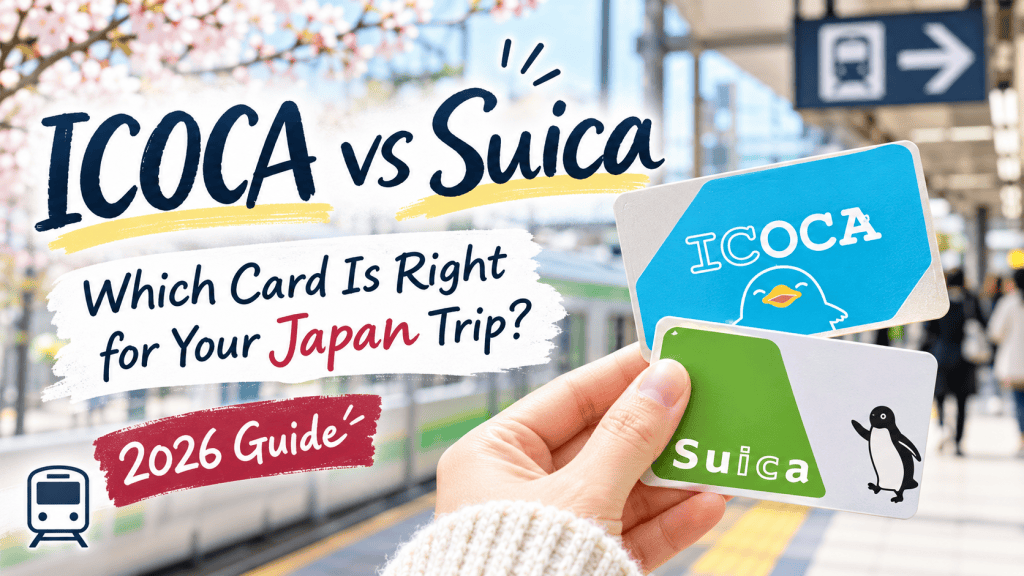
Updated November 9, 2026.
ICOCA and Suica work almost everywhere in Japan, so the real question is not which one is better. It is which one is easiest to get where you land. Here is how they compare, which one to choose for your trip, and where to buy it.
This article contains affiliate links. If you book through an affiliate link, I may earn a commission at no additional cost to you.
Quick answer
- Landing in Kansai (Osaka, Kyoto): get an ICOCA.
- Landing in Tokyo: get a Suica or a Welcome Suica.
- You only need one card. Either one works on trains, subways and buses across much of Japan.
- iPhone user: consider a mobile card so you do not need a physical one.
Are ICOCA and Suica interchangeable?
For everyday rides, yes. Both belong to the same nationwide IC card network, so an ICOCA works in Tokyo and a Suica works in Osaka and Kyoto. You can also use them at convenience stores, vending machines and many shops. A few rural lines and some local buses do not accept IC cards, so look for the IC card logo on the gate or the bus.
For more on where Suica works in Kansai, see Can You Use Suica in Osaka and Kyoto?
ICOCA, Suica and Welcome Suica at a glance
ICOCA is the JR West card, sold at Kansai Airport and at stations in Kansai. A regular physical card has a 500 yen deposit, which is refundable, and can hold up to 20,000 yen.
Suica is the JR East card with the same deposit and balance limit. Sales of regular cards were paused during the 2023 and 2024 chip shortage, but guides in 2026 report that they are available again.
Welcome Suica is a visitor card from JR East. It has no deposit and is valid for 28 days including the purchase date. Unused balance is not normally refunded. It is sold at designated JR East locations, including Narita Airport and Haneda Terminal 3.
Terms and sales locations can change, so check the operator’s official page before you travel.
Which one should you choose?
By arrival city. Choose the card that is easiest to buy where you land: ICOCA at Kansai Airport, Suica or Welcome Suica in Tokyo. You do not need a second card when you change cities.
By length of stay. A Welcome Suica expires after 28 days, so a regular card makes more sense for a long stay or a return trip, because you keep the card and any balance.
By phone. iPhone users can add a Suica to Apple Wallet or use the Welcome Suica Mobile app, and Apple lists ICOCA among the supported cards. Mobile card rules and foreign card support change, so check Apple’s and the operator’s current guidance. If your phone cannot add a mobile card, a physical card is the safe choice.
Where to buy and how to top up
- Kansai Airport: JR West ticket machines and counters sell ICOCA.
- Osaka and Kyoto: JR West stations sell ICOCA.
- Narita and Haneda: JR East counters sell Suica and Welcome Suica.
Station machines usually take yen cash for physical cards, so keep some bills with you. See How to Recharge Suica in Japan for the steps.
What an IC card does not cover
An IC card pays for each ride separately. It does not include Shinkansen or reserved long-distance tickets, and it does not give free entry to attractions. If you plan a lot of sightseeing or long rides, compare these options before you go:
- Osaka Amazing Pass (2026): Is It Worth It? for Osaka sightseeing: Osaka Amazing pass Kkday
Related reading
- Do You Need a Suica Card in Japan? Where to Buy It and How to Use It
- Can You Use Suica from Kansai Airport to Osaka? Train Options Explained
- How to Recharge Suica in Japan


Leave a Reply