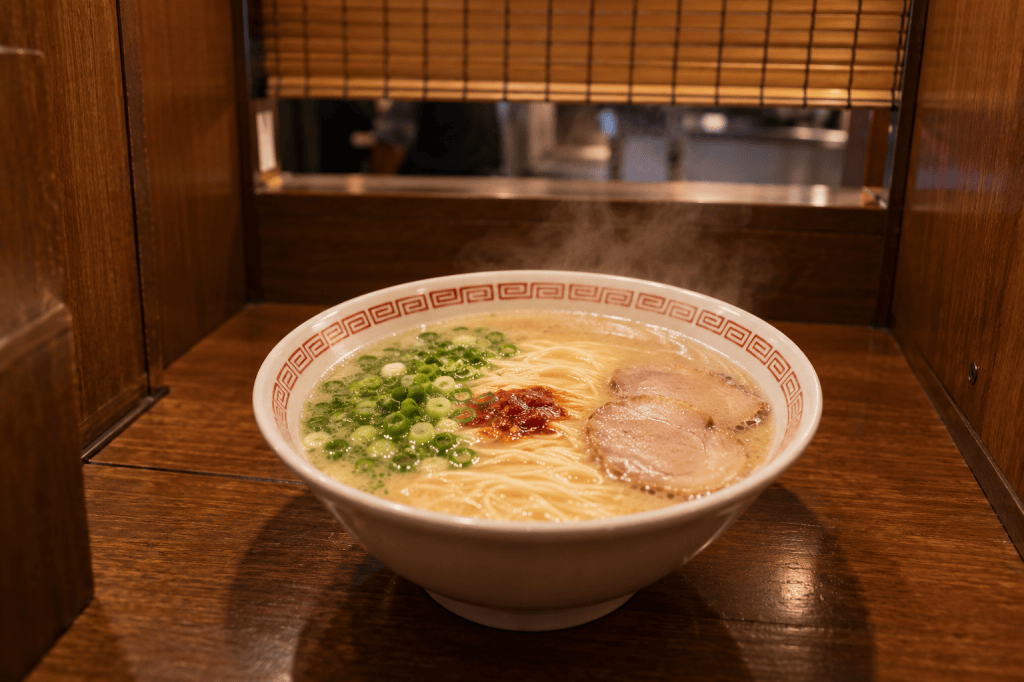
Have you heard of Ichiran?
I had heard the hype too, but my first visit still surprised me. Can you imagine going to a restaurant and eating without sharing a table with anyone? You sit in your own little space, quietly concentrating on your ramen.
The bowl they served me was certainly exceptionally delicious. But the whole experience felt a little unusual…
A meal often gives you something to talk about: “Try this!” or “What do you think?” At Ichiran, the famous booth setup turns your attention back to the bowl in front of you. I can see why people love that. Still, it was the seating—not just the ramen—that made such an impression on me.
If you’re curious about trying Ichiran in Japan, here’s what to expect, how to order, and a few things worth knowing before you join the queue.
What Is Ichiran, and What Kind of Ramen Does It Serve?
Ichiran is best known for its Classic Tonkotsu Ramen. Tonkotsu means pork-bone broth: a different thing from tonkatsu, the breaded pork cutlet you might see on other Japanese menus.
Its signature bowl combines pork-bone soup, thin noodles, sliced pork, green onions and a red chilli-based sauce. Rather than offering every ramen style, Ichiran focuses on its tonkotsu specialty and lets you adjust your bowl through an order form.
That red sauce is part of the flavour, rather than simply decoration. If you don’t enjoy spicy food, pay attention to that section of the form.
You don’t need to be a ramen expert before visiting. Knowing whether you prefer mild or spicy food is a perfectly useful starting point.
Why Does Everyone Sit Separately?
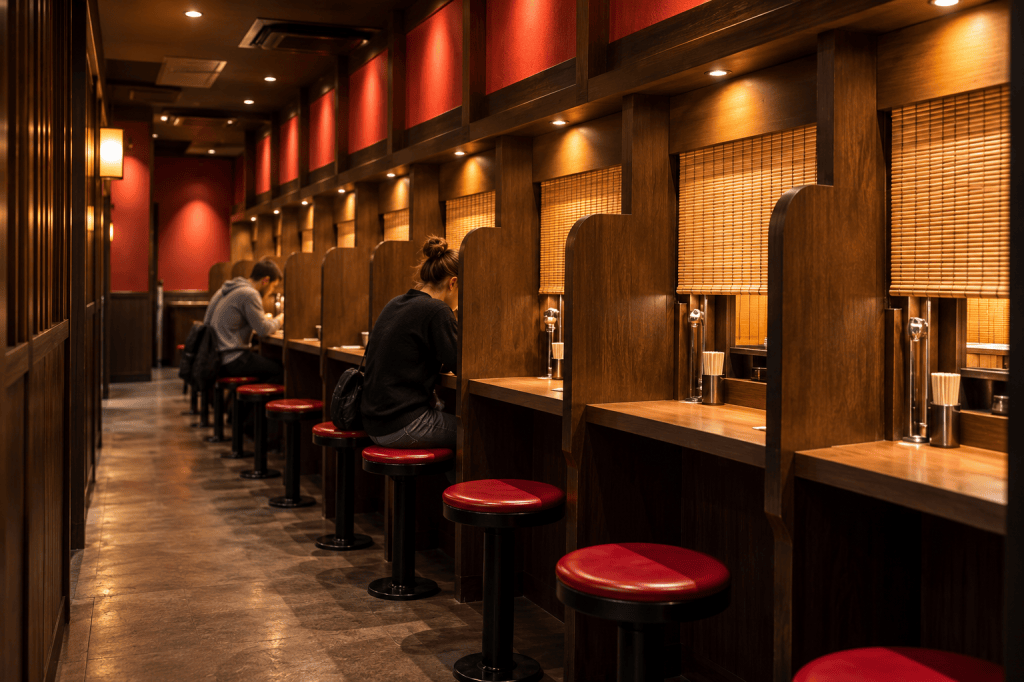
An illustration of partitioned ramen counter seating, where diners have their own space.
Ichiran calls its partitioned seating “Flavor Concentration Booths.” The idea is to reduce distractions so you can focus on your food. Wooden dividers separate neighbouring seats, and a curtain screens the service opening in front of you.
It is a shared counter divided into individual spaces, rather than a private room for every customer. Some branches also have table seating or other arrangements, so the famous booth experience isn’t the only layout across the chain.
For a solo traveller, the setup may feel comfortable: arriving alone fits naturally here. With friends, it is worth checking the branch’s seating if chatting over dinner matters to you.
How to Order at Ichiran in Japan
The details can vary by branch, but this is the usual ticket-and-booth process.
1. Buy Your Meal Tickets
Choose your ramen and any extras at the ticket machine. Payment options vary by location; many branches now accept cashless payment. Check your chosen branch rather than assuming every machine is cash-only.
2. Find Your Seat
Follow staff guidance or the seating display. The character 空 means a seat is vacant.
3. Complete the Order Form
English forms are available. Circle your preferences, then hand the form and meal tickets to staff using the booth’s call button when needed.
4. Enjoy Your Ramen
Once your bowl arrives, the curtain can be lowered. You can call staff again if you need help—you aren’t required to remain silent!
Understanding the Ichiran Order Form
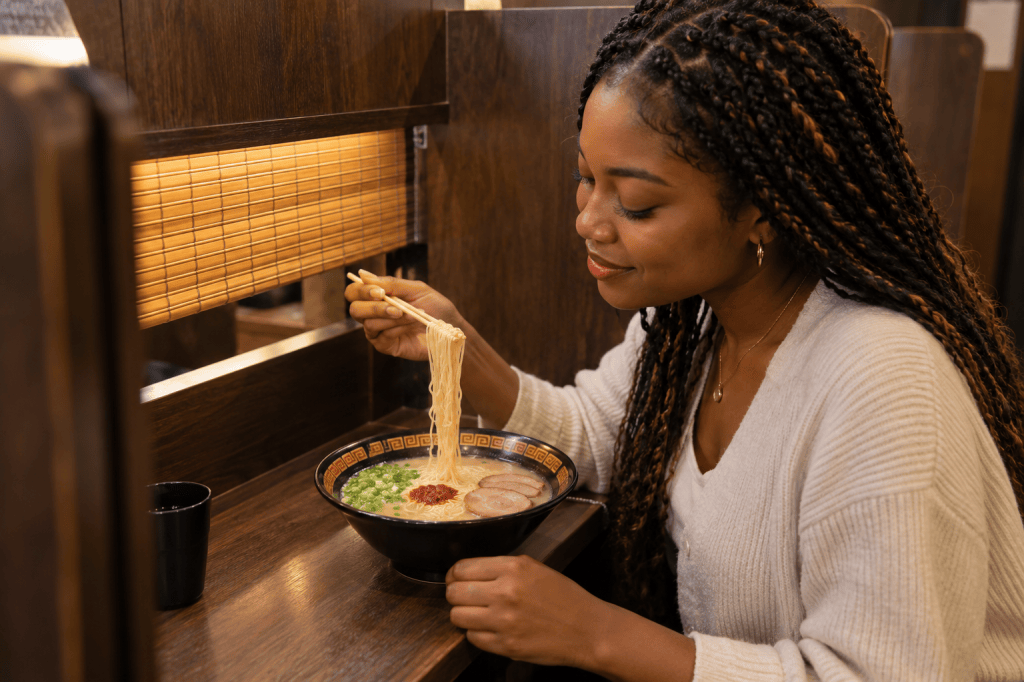
A traveller enjoying ramen in an individual booth
The form covers seven main choices:
- Flavour strength: how strongly seasoned you want the soup.
- Richness: your preferred level of richness.
- Garlic: how much garlic you want.
- Green onions: your onion preference.
- Sliced pork: whether to include chashu.
- Red sauce: your preferred amount of the spicy sauce.
- Noodle texture: how firm or soft you like your noodles.
For a first visit, my suggestion is to choose the standard or regular options where offered, then adjust anything you already know you dislike. That gives you a starting point without making the form feel like an exam.
If you dislike spicy food, choose no red sauce or a smaller amount. If you’re unsure about noodle firmness, regular is a reasonable place to begin. These are suggestions, not a rule about the “correct” way to eat ramen.
There is no need to copy somebody else’s highly specific combination. Your ideal bowl may be quite different from theirs.
What Is Kaedama, and How Do You Order It?
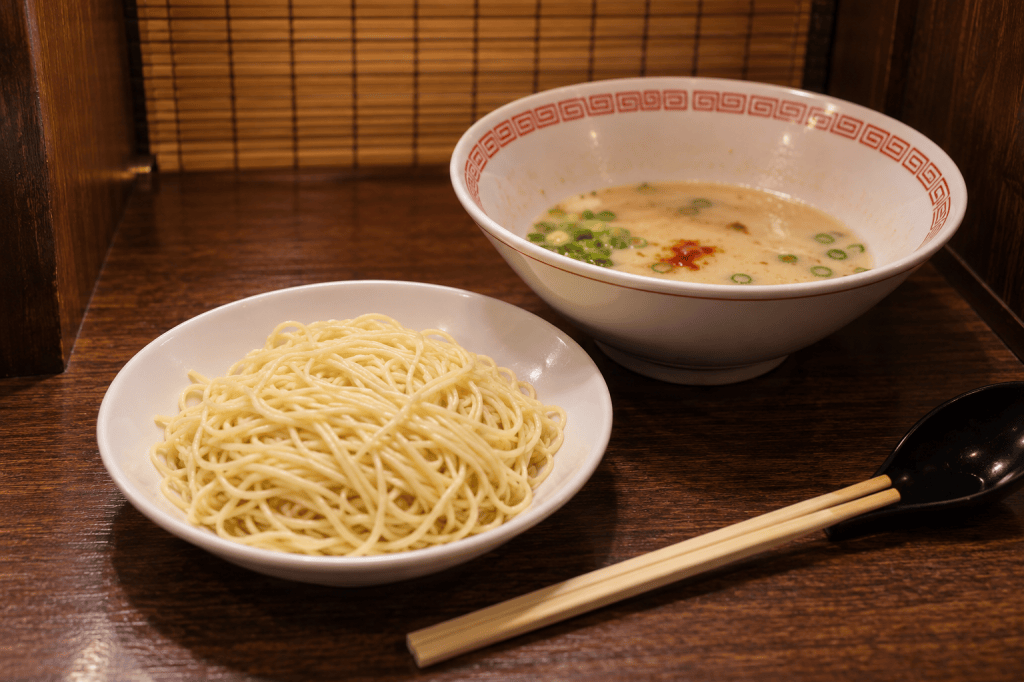
Kaedama adds fresh noodles to your remaining broth, rather than replacing the whole meal.
Kaedama is an extra portion of noodles for the soup you already have. It is not a second complete bowl of ramen.
If you want a refill, keep plenty of broth in your bowl; Ichiran recommends leaving at least half. When you’ve purchased kaedama and received its metal plate, place that plate on the booth’s call button to signal that you’re ready.
You can also ask staff about ordering extra noodles during your meal. If you want the refill cooked to a different firmness, tell them when ordering it.
The useful thing to remember is simple: don’t drink all your soup before deciding whether you want more noodles.
How Much Does Ichiran Cost?
For a concrete example, the official Fukuoka Main Store page listed these prices when checked in October 2026:
- Classic Tonkotsu Ramen: ¥1,080.
- Kaedama: ¥210.
- Soft-boiled salted egg: ¥140.
A bowl with those two extras would therefore be ¥1,430, before any applicable additional charges. This is an example for that branch, not a guaranteed price for every Ichiran restaurant.
The same page notes a late-night surcharge between 10 p.m. and 6 a.m. Check your chosen branch’s current menu and conditions before visiting.
Queues, Opening Hours and Choosing a Branch
Ichiran’s official FAQ says it does not take reservations. Leave some flexibility in your plans rather than building an evening around a precise waiting time.
Trying an earlier lunch or a meal outside the main dinner period may help, but it doesn’t guarantee a short queue. A less convenient branch isn’t automatically worth a long detour either.
My practical suggestion is to look for a location near somewhere you already plan to visit. Check its opening hours, menu, payment options and seating before you go. Don’t assume every branch is open 24 hours or offers the same experience.
Find your branch on Ichiran’s official website.
Can Vegetarians or Vegans Eat Ichiran’s Ramen?
The Classic Tonkotsu Ramen is not vegetarian or vegan. Removing the pork slices does not change the pork-bone broth underneath.
Some specialised locations offer pork-bone-free ramen, but that does not mean plant-based. Ichiran explicitly states that its pork-bone-free restaurant menu is not vegan.
Food allergies need a separate check too. The official information for Classic Tonkotsu Ramen lists wheat, milk, eggs, soy, pork and gelatin, and warns that cross-contact cannot be ruled out. Don’t judge suitability from the visible toppings alone.
Read Ichiran’s official allergy information.
Is Ichiran Worth Trying?
If you’re curious about its ramen and the individual booth setup, it can be an interesting meal to include in your Japan trip. Knowing the process beforehand makes the unusual setting easier to enjoy.
But I wouldn’t make one famous chain your entire ramen experience. Leave room for another shop too—perhaps somewhere with a different broth or a more conversational atmosphere.
For me, the ramen was exceptionally delicious. The quiet little booth was the surprise. If you visit, I’d be interested to know which stays with you more: the flavour, or the feeling of eating in your own small world.
Practical information checked against Ichiran’s official website in October 2026. Prices, menus, opening hours and services may change.


Leave a Reply