Japan is welcoming more visitors than ever. According to the Japan National Tourism Organization (JNTO), annual visitor arrivals rose from 3.8 million in 2022 to 42.7 million in 2025. Those figures include some people travelling for reasons other than holidays, but the increase is striking.
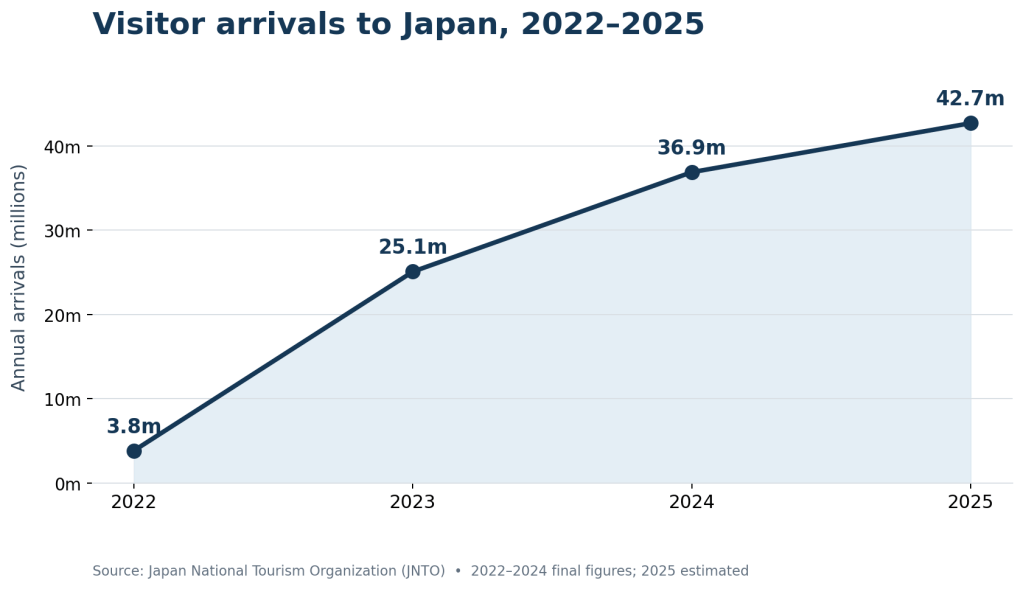
Annual visitor arrivals to Japan, 2022–2025. Source: Japan National Tourism Organization (JNTO).
Will people speak English in Japan?
Well, sometimes! At popular attractions, hotels and larger shops, you’ll often find someone who can help you in English. For shopping and meals, pictures and pointing can get you a long way too.
But you might also visit a small café or a local station where English doesn’t get you very far. That’s why I think it’s nice to have a few Japanese words ready. You don’t need to make a perfect sentence. Sometimes “excuse me” and “this one, please” are all you need.
Four greetings you’ll definitely use
1. おはようございます — Ohayō gozaimasu — Good morning
Say this when you greet someone in the morning.
2. こんにちは — Konnichiwa — Hello
A greeting for the daytime.
3. こんばんは — Konbanwa — Good evening
Use this when you arrive somewhere in the evening.
4. ありがとうございます — Arigatō gozaimasu — Thank you
You’ll probably use this one more than any other phrase on the list. I certainly do.
Six little phrases that come in handy
5. すみません — Sumimasen — Excuse me
This is the word to start with when you want to ask a question or get someone’s attention politely.
6. これをお願いします — Kore o onegaishimasu — This one, please
Point to a menu item or something in a shop and say this. Simple!
7. 大丈夫です — Daijōbu desu — I’m okay, thanks
Useful when you don’t need something you’ve been offered. A small head shake helps make your meaning clear.
8. いくらですか? — Ikura desu ka? — How much is it?
Handy when a price isn’t displayed.
9. トイレはどこですか? — Toire wa doko desu ka? — Where is the toilet?
One to save on your phone, just in case.
10. もう一度お願いします — Mō ichido onegaishimasu — Once more, please
If someone answers and you don’t quite catch it, you can ask them to repeat themselves.

Want to put your own sentence together?
Here’s an easy pattern to try:
私は〇〇です。 — Watashi wa 〇〇 desu. — I’m 〇〇.
For example, Watashi wa Emma desu means “I’m Emma.” You can also say Watashi wa bejitarian desu to tell someone you’re vegetarian.
In everyday conversation, Japanese speakers often leave out watashi wa when it’s clear who they’re talking about. Emma desu is fine as an introduction too. But the full pattern gives you somewhere easy to start.
You don’t have to memorise all ten phrases before you arrive. Pick a few you think you’ll use, save this page, and give them a try. Even if you need to point, smile and repeat yourself, that little moment when someone understands you feels pretty good.


Leave a comment