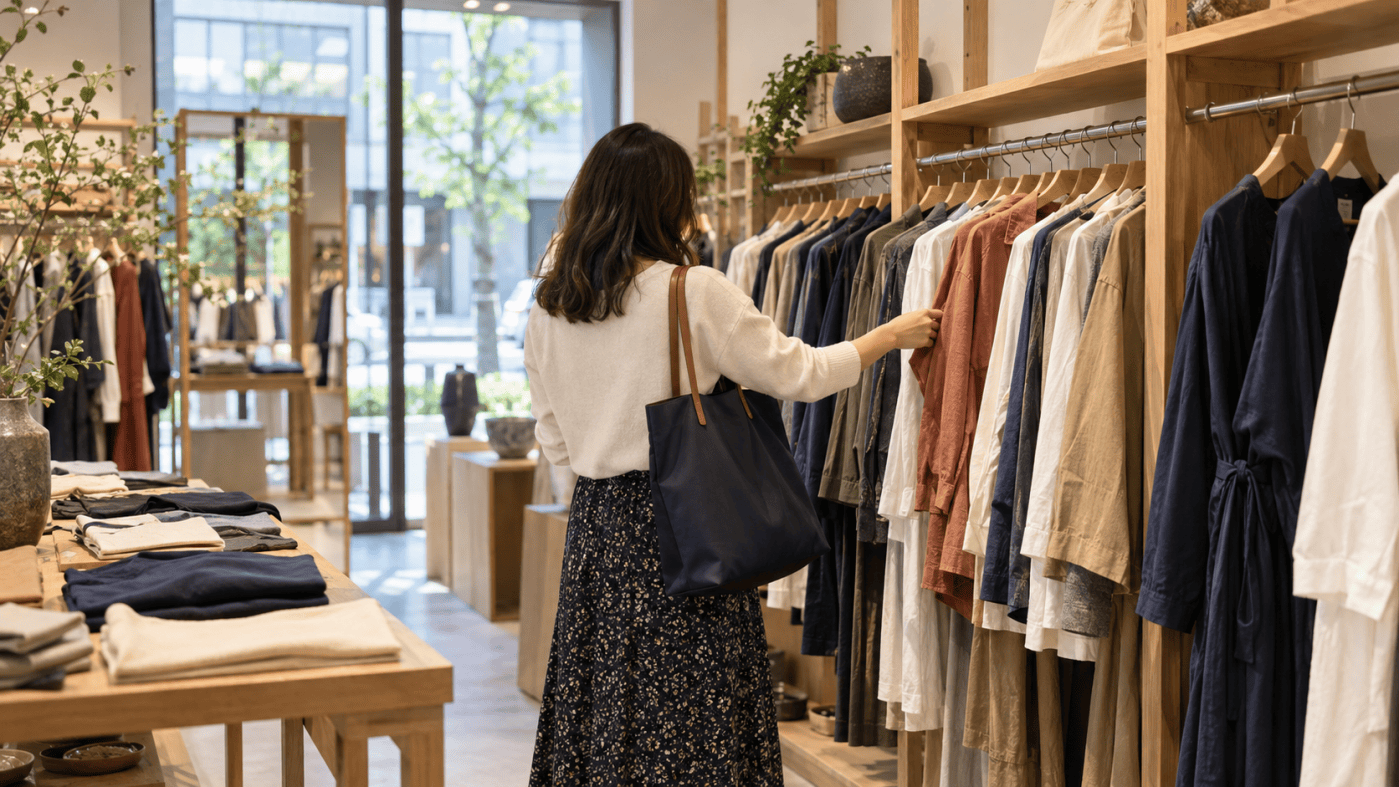
Shopping for clothes in Japan can be a lot of fun.
You can find affordable everyday fashion, simple Japanese designs and items that may not be available in other countries. Stores such as UNIQLO, GU and MUJI are popular with travelers, but smaller boutiques and department stores are also worth exploring.
There is just one thing that can make shopping a little confusing: Japanese sizes.
A size M in Japan may not fit exactly like a size M in your country. Shoe sizes are also written in centimeters, while children’s clothing is usually based on height.
Well, it may look complicated at first, but it becomes much easier once you know what to check.
Are Japanese Clothing Sizes Smaller?
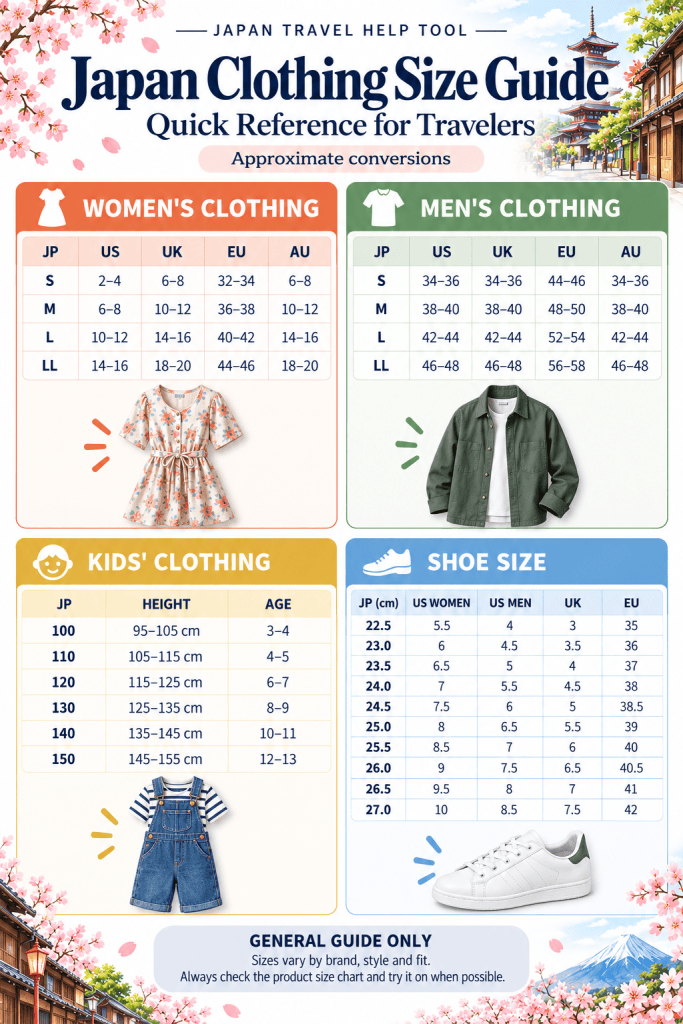
A simple guide to Japanese clothing and shoe sizes. Sizing may vary by brand, design and fit.
In general, Japanese clothing can feel smaller or narrower than clothing sold in the US, UK, Europe or Australia.
However, this does not mean that you should always choose one size larger.
The fit depends on the brand, the item and the style. A loose-fitting Japanese shirt may still feel roomy, while a fitted dress or jacket may feel smaller around the shoulders, chest or hips.
Personally, I think it is better to use the letter on the label as a starting point—not as a guarantee.
If you usually wear a size M, try the Japanese M first. If it feels too fitted, compare it with an L. Whenever possible, check the measurements or try the item on before buying it.
A Quick Guide to Japanese Women’s Sizes
Women’s clothing in Japan is commonly labeled with sizes such as S, M, L and LL or XL.
You may also see numbered sizes such as 7, 9, 11 and 13, especially in department stores or for more formal clothing.
Here is a very rough guide:
- Japanese S: often similar to an international XS or small S
- Japanese M: often similar to an international S or small M
- Japanese L: often similar to an international M or small L
- Japanese LL or XL: often similar to an international L
These are only general comparisons. Two Japanese brands can use the same size label but have different measurements.
The shape of the garment also matters. Sleeves may be shorter, shoulders may be narrower and trousers may fit differently around the waist and hips.
That is why checking the actual measurements is usually more reliable than relying only on the size letter.
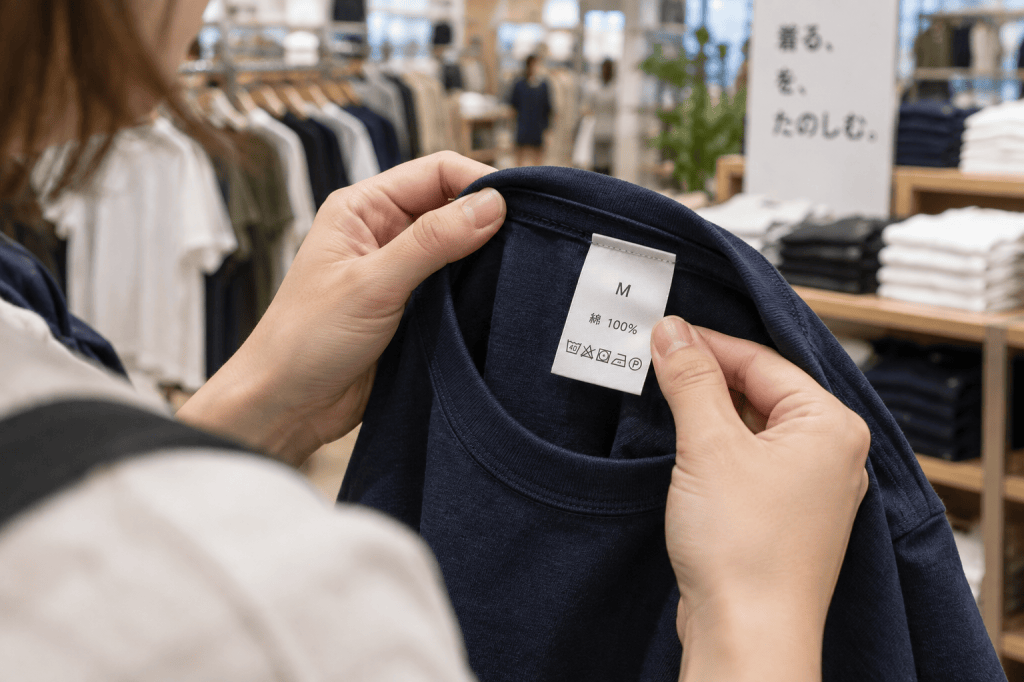
The same size label can fit differently depending on the brand and design.
Japanese Men’s Clothing Sizes
Men’s clothing also commonly uses S, M, L and XL.
Japanese men’s tops and jackets may feel slightly shorter or narrower than similar items sold overseas. This can be especially noticeable in the shoulders, chest and sleeve length.
For trousers, look for the waist measurement in centimeters. Some shops also display the inseam length, which is useful if you are taller.
If you are between two sizes, I would probably try the larger one first—especially when shopping for a fitted shirt, jacket or coat.
Oversized and relaxed-fit clothing is very popular in Japan, though, so not every item will feel small. Always look at the cut as well as the label.
Children’s Clothing Sizes in Japan
Japanese children’s clothing is usually labeled according to the child’s height in centimeters.
For example:
- Size 100: designed for a child around 100 cm tall
- Size 110: designed for a child around 110 cm tall
- Size 120: designed for a child around 120 cm tall
- Size 130: designed for a child around 130 cm tall
- Size 140: designed for a child around 140 cm tall
- Size 150: designed for a child around 150 cm tall
This system is actually quite practical because children of the same age can have very different heights.
The number is still only a guide, of course. If the child is between sizes or you want the clothes to last longer, choosing the next size up may be more comfortable.
Japanese Shoe Sizes
Shoe shopping in Japan is often easier than clothing shopping because Japanese shoe sizes are generally shown in centimeters.
If a shoe is labeled 24.0, for example, it is intended for a foot approximately 24 centimeters long.
Here is a rough women’s shoe-size guide:
- Japan 22.5 cm: around US 5.5 / UK 3 / EU 35–36
- Japan 23.0 cm: around US 6 / UK 3.5 / EU 36
- Japan 23.5 cm: around US 6.5 / UK 4 / EU 37
- Japan 24.0 cm: around US 7 / UK 4.5 / EU 37–38
- Japan 24.5 cm: around US 7.5 / UK 5 / EU 38
- Japan 25.0 cm: around US 8 / UK 5.5 / EU 39
For men, a 27.0 usually means a shoe designed for a foot approximately 27 centimeters long.
However, the width and shape of a shoe can make a big difference. Some Japanese shoes may feel narrower, while sneakers from international brands may fit more like the sizes you already know.
Trying the shoes on is always the safest option.
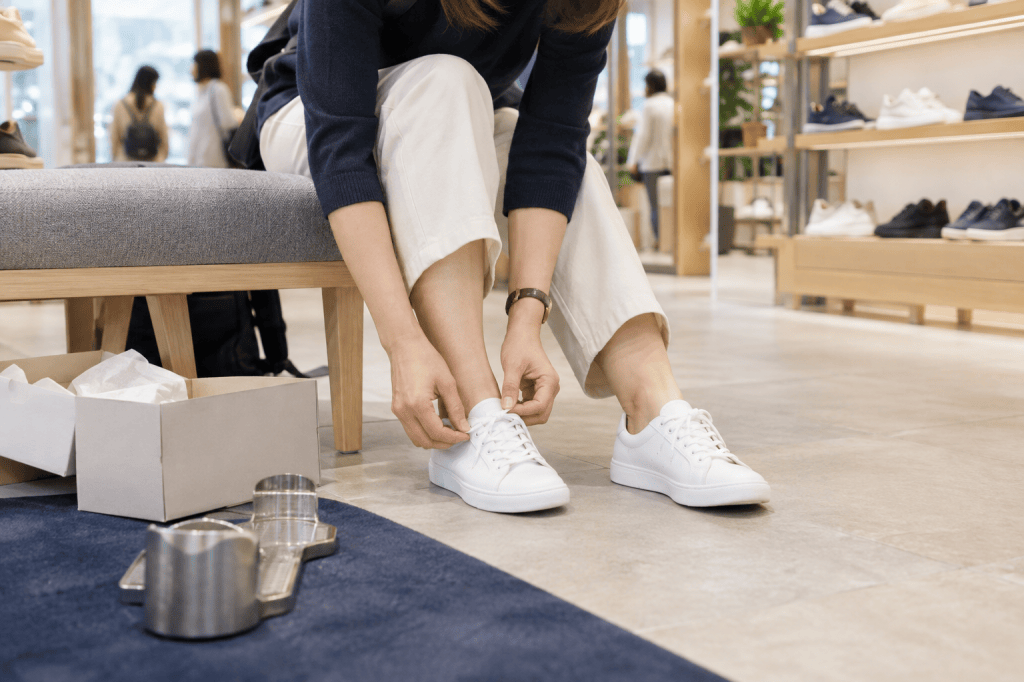
Japanese shoe sizes are usually displayed in centimeters.
How to Measure Your Foot
Before your trip, place your foot on a sheet of paper while standing normally.
Mark the back of your heel and the tip of your longest toe, then measure the distance between the two points in centimeters.
Measure both feet because one may be slightly larger than the other. Use the measurement of the larger foot when choosing shoes.
It is also helpful to measure your foot later in the day, when it may be slightly more swollen.
Trying on Clothes in Japan
Most larger clothing stores in Japan have fitting rooms.
You can usually take the item to the fitting-room area and tell the staff how many pieces you would like to try on.
In some stores, you may need to remove your shoes before stepping into the fitting room. Look at the floor and follow the store’s setup. If there is a raised carpeted area, your shoes will usually stay outside it.
Some stores also provide a thin face cover to protect clothing from makeup. Place it over your face before pulling a top or dress over your head.
If you are not sure what to do, do not worry. The staff will normally show you.
Useful Japanese Phrases for Shopping
Here are a few simple phrases that may help:
Can I try this on?
Kore o shichaku shite mo ii desu ka?
これを試着してもいいですか?
Do you have a larger size?
Motto ookii saizu wa arimasu ka?
もっと大きいサイズはありますか?
Do you have a smaller size?
Motto chiisai saizu wa arimasu ka?
もっと小さいサイズはありますか?
Do you have this in size M?
Kore no M saizu wa arimasu ka?
これのMサイズはありますか?
Where is the fitting room?
Shichakushitsu wa doko desu ka?
試着室はどこですか?
Even if you do not speak much Japanese, pointing to the item and showing the size on your phone usually works.
Where to Shop for Clothes in Japan
Japan has plenty of choices for different styles and budgets.
UNIQLO
UNIQLO is a convenient place to shop for simple basics, travel clothing and seasonal items. Many stores carry a wide selection of sizes, although the full range may sometimes be easier to find online.
GU
GU is known for affordable and trend-focused fashion. It is a good place to look for casual clothing and try current Japanese styles without spending too much.
MUJI
MUJI offers simple, relaxed clothing in neutral colors. Personally, I like it for comfortable basics and items that are easy to wear with clothes you already own.
Department Stores
Japanese department stores offer everything from casual fashion to luxury brands. They can also be helpful if you want attentive service or several brands in one place.
Shopping Malls and Smaller Boutiques
Shopping malls are useful because you can compare many stores in the same building.
Smaller boutiques can be more interesting if you are looking for something unique, but their size range may be limited.
Check the Return Policy Before Buying
Return and exchange rules differ between stores.
Some shops accept returns if the item is unused and you have the receipt. Others may only offer exchanges, and certain discounted, altered or personal items may not be returnable.
Actually, this is especially important for travelers because returning to the same store may not be easy once you have moved to another city.
Keep your receipt, leave the tags attached until you are sure and check the store’s policy before buying an expensive item.
My Tips for Finding the Right Size
Here are a few simple ways to avoid buying the wrong size:
- Know your basic measurements in centimeters.
- Check the individual product’s size chart.
- Compare garment measurements rather than only comparing S, M and L.
- Try on fitted clothes, trousers, jackets and shoes whenever possible.
- Check the shoulder width, sleeve length and inseam.
- If you are between sizes, compare both.
- Keep your receipt and tags.
- Do not assume that every Japanese brand fits the same way.
Final Thoughts
Shopping in Japan is part of the travel experience.
You may find simple basics, fun seasonal items or a piece of clothing that reminds you of your trip every time you wear it.
Japanese sizes can seem confusing at first, but you do not need to memorize a perfect conversion chart. Know your measurements, treat size labels as a guide and try things on whenever you can.
Most importantly, take your time and enjoy looking around.
Save this guide for your Japan trip—and hopefully your next Japanese shopping experience will be a little easier! 🇯🇵
 Japan Travel Note
Leave a comment