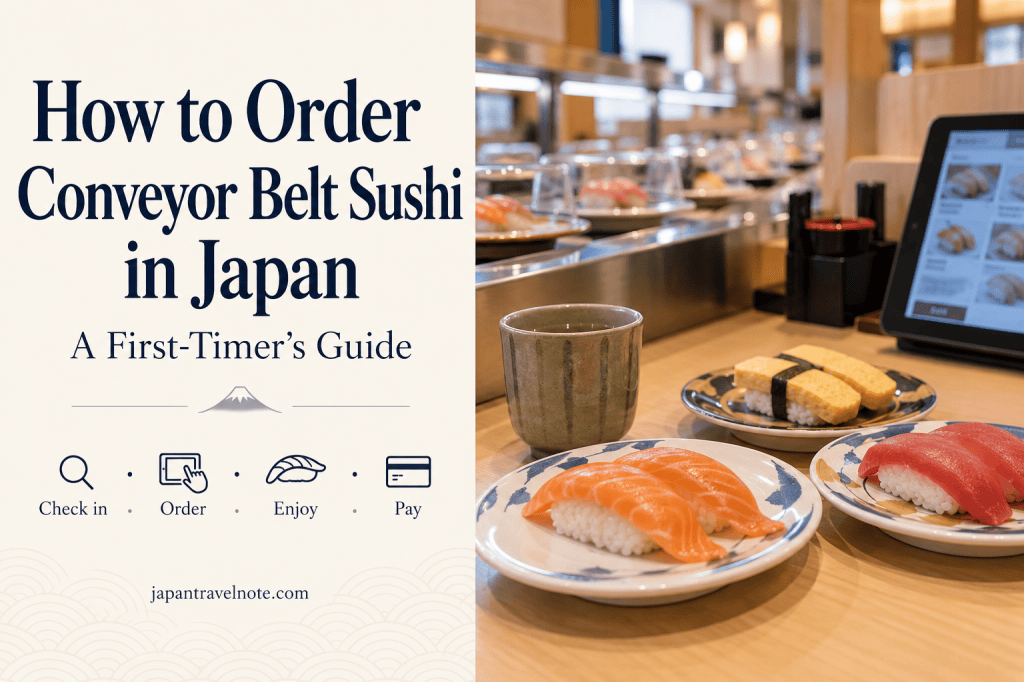
Want to try conveyor belt sushi in Japan, but not quite sure what to do when you walk in?
The reception machine, ordering screen and hot-water tap can look a little confusing at first. Once you understand the basic flow, though, you can settle in and enjoy choosing your food.
As someone from Japan, I would suggest starting with a few dishes you recognise, then adding something new if you feel like it. You do not need to order your whole meal at once.
Here is a practical guide from the entrance to the checkout.
First, Know That Every Restaurant Is a Little Different
Conveyor belt sushi is often called kaiten-zushi in Japanese.
Some restaurants have plates circulating for customers to choose from. Others mainly use screens and delivery lanes, so you order first and your food arrives at your seat.
Even branches of the same chain can have different equipment. Use this guide as an overview and follow the instructions at the restaurant you visit.
1. Check In at the Entrance
Look for a reception machine or a member of staff rather than sitting down immediately.
If there is a queue, register your group and keep any numbered ticket. If you already have a reservation, follow the restaurant’s check-in instructions; making a booking may not complete your arrival check-in.
Wait for your number or seating instructions. At some restaurants, a machine gives you a slip showing your assigned seat.
If you are unsure, show the ticket to staff. There is no need to guess which table is yours.
2. Find Your Seat and Keep the Table Slip
Go to the assigned counter seat or table.
Keep any seat-number slip nearby until you have paid. It may be used during checkout.
Before ordering, take a moment to locate the screen, chopsticks and condiments. Some supplies are tucked inside a drawer or compartment.
My advice would be to get comfortable first. You can look through the menu without feeling that you must order immediately.
3. Choose a Language and Check the Menu
Look for the language option on the ordering screen.
Sushiro’s official English site lists multilingual touch-panel ordering, including English. Equipment and language options elsewhere may differ.
You may see categories for nigiri, rolls, side dishes, desserts and drinks.
Check both the price and the serving size. One item may contain one piece, while another contains two. Do not assume every plate costs the same or that all branches have identical prices.
4. Order a Few Dishes at a Time
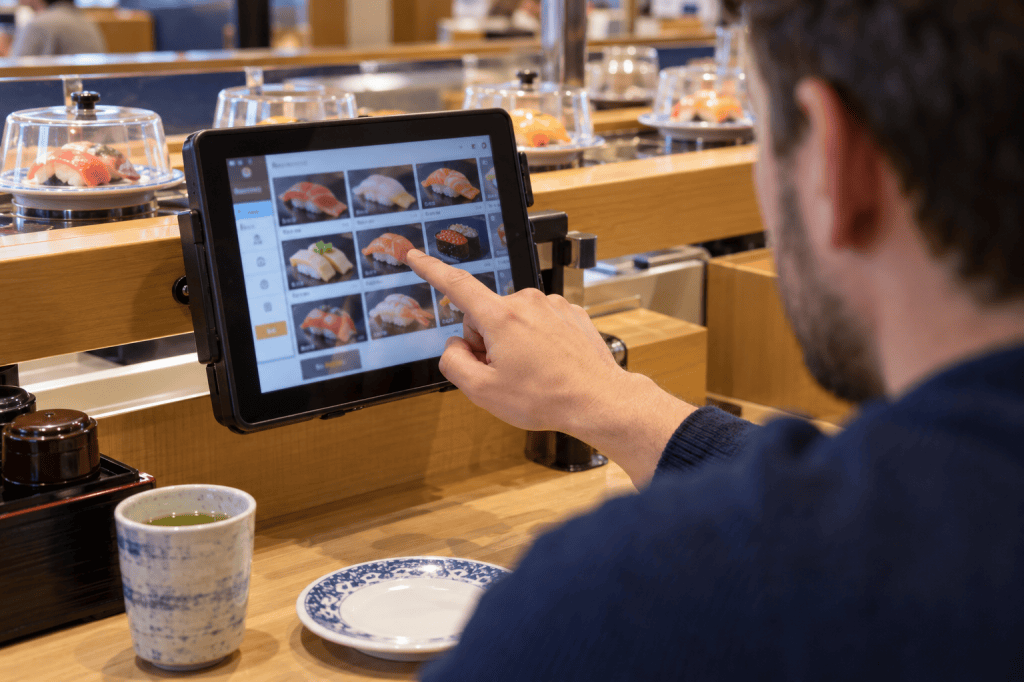
Choose your dishes on the ordering screen.
Choose your dishes and follow the screen’s confirmation steps.
At some newer Sushiro branches, a large display shows moving sushi images that you can tap to order. Those are digital pictures, rather than actual plates to pick up.
Start small. For example, I would choose two or three plates, enjoy those, then decide what to order next.
If an item does not seem to have been ordered, check the order history or ask for help before tapping again. Otherwise, you could accidentally order it twice.
5. Collect the Food Meant for Your Seat
Collect the food delivered to your seat.
Watch for an arrival message, sound or food stopping beside your table.
With an order-delivery system, take only the food delivered or identified for your seat. Newer systems may use a dedicated lane for each table.
If the restaurant has a shared circulating belt, follow its instructions for selecting plates. Covered plates may have a particular opening mechanism.
Once you have taken a plate, keep it off the belt. If you pick up something by mistake, ask staff what to do.
6. Make Your Tea
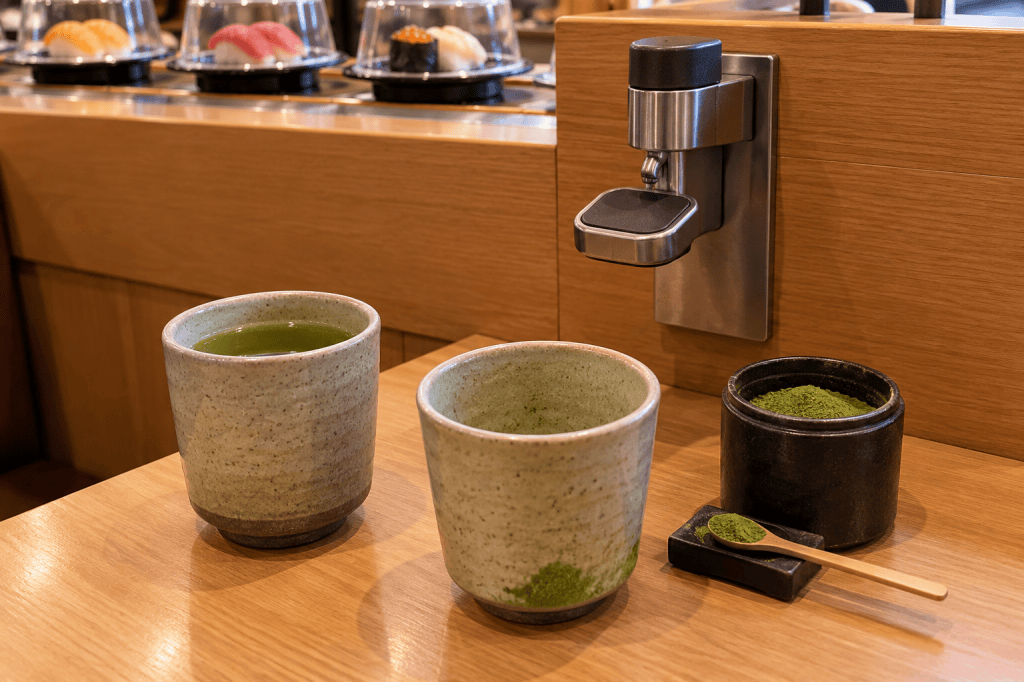
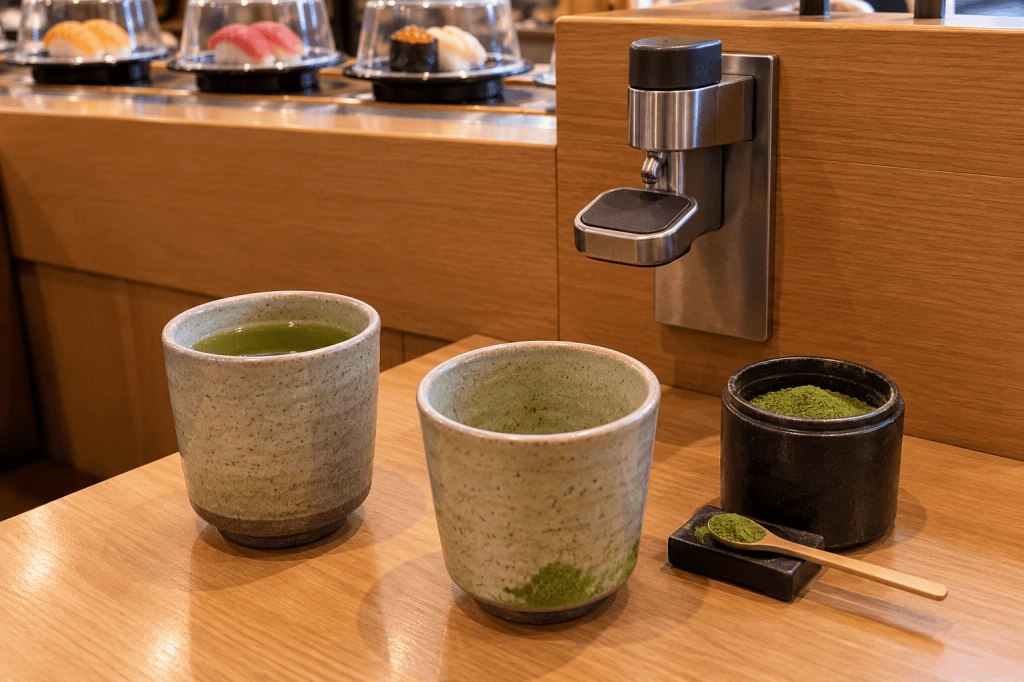
Self-service tea setups vary by restaurant. Follow the instructions provided.
Many chain restaurants provide self-service green tea using powder and a hot-water dispenser.
Where that setup is provided, use a cup, add the amount of powder shown in the instructions, then operate the dispenser as directed.
Be careful: the water is hot. Help young children rather than letting them use the tap alone.
If you cannot find tea, cups or drinking water, ask staff. Do not assume every tap or container at the table serves the same purpose.
7. Enjoy Your Food and Keep Track of Plates
Add soy sauce or wasabi according to your taste and the instructions provided.
For a first visit, I would use a little at a time rather than adding a lot before trying the sushi.
What happens to empty plates depends on the restaurant. Some ask you to keep them on the table; Kura Sushi uses a return slot for suitable sushi plates.
Only put items into a return slot if the instructions say they belong there. Bowls, cups and other dishes may need to stay on the table.
8. Request Checkout and Pay
When you have finished, look for the checkout or payment-request option on the screen, or ask staff.
Follow any steps to confirm the bill. Depending on the restaurant, staff may check your dishes or the system may calculate them automatically.
Then take the required table slip or payment ticket to the checkout area. This may be a staffed register or a self-service machine.
Check the payment options available at that branch. Do not assume that every restaurant accepts the same cards, apps or transport IC cards.
What If You Do Not Like Raw Fish?
You can still look through the menu.
Depending on the restaurant, options may include egg sushi, cooked seafood, cucumber rolls, inari sushi, noodles or other side dishes. The current menu is what matters.
One detail to check: seared fish is not necessarily cooked all the way through. Ask staff if you need a fully cooked option.
For allergies or dietary requirements, use the restaurant’s ingredient and allergen information rather than relying on a menu photograph.
Three Simple Phrases That May Help
Sumimasen.
Excuse me. Useful when you need a member of staff.
Eigo no menu wa arimasu ka?
Do you have an English menu?
Okaikei onegaishimasu.
The bill, please.
You can also point to the screen or show your table slip. A few words and a clear gesture can make the situation easier.
Before Your First Visit
Check the branch’s opening hours and booking options. If your schedule allows, I would choose a time outside the busiest meal periods.
Once inside, take your time with the screen, order a little at a time and ask if something is unclear.
The first visit is when you learn the system. After that, the next meal is much easier—and you can spend more time deciding which sushi to try.


Leave a Reply