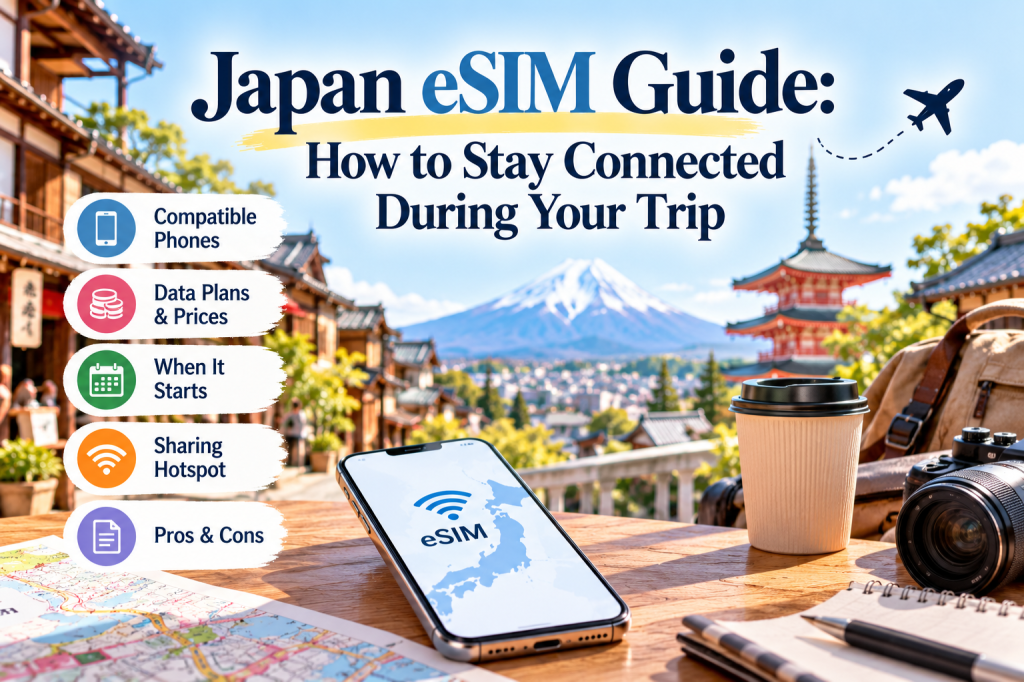
Imagine arriving in Japan, stepping out of the airport and trying to find your way to your hotel.
You open Google Maps, look up the train route and perhaps try to translate a sign. Then you realise you don’t have an internet connection.
Not exactly the start to your holiday you were hoping for!
These days, I think having mobile data is one of the most useful things you can arrange before travelling to Japan. Whether you’re exploring Tokyo, catching a shinkansen or searching for somewhere to eat, you’ll probably use your phone more than you expect.
So, should you get an eSIM, rent pocket Wi-Fi or buy a regular SIM card?
Here’s what I’d check before making a decision.
Why Is Mobile Data So Useful in Japan?
Japan has plenty of public Wi-Fi, but I wouldn’t want to depend on finding it everywhere.
For me, these are the main reasons to have mobile data while travelling:
- Google Maps: Find your way around unfamiliar streets.
- Train navigation: Check routes, transfers and departure times.
- Translation: Understand menus, signs and useful Japanese phrases.
- Restaurant searches: Find somewhere nearby when you’re hungry.
- Staying in touch: Message family, friends or your accommodation.
Having internet access is especially convenient when you’re moving between different cities or travelling with children.
And although getting a little lost can be part of the adventure, sometimes you just want to find your hotel!
What Exactly Is an eSIM?
An eSIM is a digital SIM that allows a compatible smartphone to connect to a mobile network without inserting a physical SIM card.
Instead of visiting a shop and changing the SIM card in your phone, you can purchase a travel eSIM online and follow the provider’s installation instructions.
For many travellers, that means one less thing to organise after landing.
However, not every phone supports eSIM, and some phones are locked to a particular mobile carrier. It’s important to check both before buying.
eSIM vs Pocket Wi-Fi: Which Should You Choose?
Both can be useful, but they suit different kinds of trips.
1. Easy to Carry
eSIM: Installed digitally on your phone. No additional device to carry.
Pocket Wi-Fi: A separate portable device that you’ll need to carry and charge.
2. Travelling Alone or in a Group
eSIM: Convenient for individual travellers. Some plans also allow hotspot sharing.
Pocket Wi-Fi: Useful for families or groups who want to share one internet connection.
3. Setup and Compatibility
eSIM: Requires an eSIM-compatible, unlocked smartphone.
Pocket Wi-Fi: Connects compatible devices through Wi-Fi, so your phone doesn’t need to support eSIM.
4. Battery Life
eSIM: No separate device to charge, although using mobile data can drain your phone’s battery.
Pocket Wi-Fi: Has its own battery and needs regular charging.
5. Which Is Better for Your Trip?
If you’re travelling alone and prefer to keep things simple, an eSIM could be a convenient option.
If you’re travelling with family or friends and want everyone to share one connection, pocket Wi-Fi may be worth considering.
Personally, I like the idea of having everything on one phone. When you’re already carrying luggage, shopping bags or children’s belongings, keeping things simple is appealing.
However, there’s no single answer for everyone. Think about how many people are travelling, whether your phone supports eSIM and how you’ll use the internet.
How Much Data Do You Need in Japan?
This depends on your travel habits.
If you mainly use Google Maps, check train routes and send occasional messages, your needs may be quite different from someone who uploads videos or streams content every day.
Before choosing a plan, ask yourself:
- How many days will I be in Japan?
- Will I mainly use maps and messaging?
- Will I upload lots of photos and videos?
- Do I need to share my connection with another device?
- Will I have reliable Wi-Fi at my accommodation?
Unlimited plans can be convenient, but don’t assume that every unlimited plan provides unlimited high-speed data. Always check the specific package’s high-speed allowance and any fair-use conditions.
A Japan eSIM Option to Consider
If you’re looking for an eSIM before your trip, one option to explore is the Japan eSIM available through KKday.
The product page offers different data allowances and plan durations, including unlimited options. It also lists hotspot sharing as an available feature.
What I like about this type of travel product is the convenience of being able to compare options and arrange mobile data before departure.
However, check the exact package you select. Network arrangements, plan conditions and available options may differ.
Check Japan eSIM Plans on KKday
Affiliate disclosure: This article contains an affiliate link. I may earn a commission if you make a purchase through it, at no additional cost to you.
5 Things to Check Before Buying a Japan eSIM
This is the section I’d pay particular attention to before purchasing.
1. Is Your Phone Compatible?
First, make sure your smartphone supports eSIM.
Don’t assume that every iPhone or Android device does. Compatibility can vary depending on the model and where the phone was originally purchased.
2. Is Your Phone Unlocked?
An eSIM-compatible phone may still be locked to your current mobile carrier.
Check with your carrier if you’re unsure.
3. When Does Your Plan Start?
This is important!
Some travel eSIMs begin their validity period when installed or activated. Follow the instructions for your specific package so you don’t accidentally start your plan too early.
4. Does Your Plan Include Calls and Texts?
Some travel eSIMs provide mobile data only.
The KKday product featured here excludes traditional voice calls and SMS. You can still use internet-based messaging and calling apps, provided you have a working data connection.
5. What Happens If Your Plans Change?
Read the cancellation and refund conditions before purchasing.
Also, check the available support instructions in case you have trouble installing or connecting your eSIM.
How Do You Set Up an eSIM for Japan?
The exact process depends on your phone and provider, but the general steps are straightforward.
- Check your phone’s compatibility and carrier-lock status.
- Choose and purchase an appropriate eSIM plan.
- Follow the installation instructions provided after purchase.
- Check when your plan becomes active.
- Select the travel eSIM for mobile data when you’re ready to use it in Japan.
You’ll need an internet connection to install an eSIM, so plan ahead.
For the KKday product mentioned above, follow its specific activation instructions, including the data-roaming settings for the travel eSIM. Check your regular carrier’s roaming settings separately to avoid unexpected charges.
I’d also save the installation instructions somewhere accessible before leaving home.
My Tips for Staying Connected in Japan
Even with mobile data, there are a few little things I’d do before travelling.
Download offline maps. They’re useful as a backup if you temporarily lose your connection.
Save your hotel’s address. Keep both the English and Japanese versions if possible.
Take screenshots of important bookings. Train reservations, hotel details and attraction tickets are easier to access when they’re already saved.
Carry a portable charger. Using maps and taking photographs throughout the day can drain your phone’s battery.
These are simple preparations, but they can make travelling feel much easier.
Is an eSIM Worth Getting for Japan?
If you have a compatible phone and prefer not to carry another device, an eSIM is certainly worth considering.
For me, the main benefit is convenience. Having access to maps, train information and translation whenever you need them can make exploring Japan much more comfortable.
But choose a plan that matches your trip rather than automatically buying the largest package.
If you’re still deciding, you can compare the available options, durations and conditions here:
Explore Japan eSIM Options on KKday
Then you can get back to planning the more exciting parts of your holiday—where to go, what to eat and everything you want to experience in Japan.


Leave a comment